Tracker comparison · ByteTrack vs FastTrack
ByteTrack vs FastTrack
A head-to-head of ByteTrack and FastTrack for multi-object tracking behind YOLO: how fast each runs across 10 NVIDIA GPUs and how steadily it holds object IDs, measured on the same clip and the same detector.
The verdict: On an NVIDIA H100, ByteTrack is the quicker of the two at 106 FPS versus 104 for FastTrack, and it stays out front on 5 of the 10 GPU tiers. ByteTrack is the steadier tracker: 17 ID fragmentations against 24 for FastTrack (29% fewer) on the same clip. That hands ByteTrack both the speed and the cleaner IDs on this hardware, making it the safer default: step up to FastTrack for teams that want high FPS without ByteTrack's occasional ID churn.
ByteTrack and FastTrack each lead on 5 of the 10 GPU tiers.
Only 17 ID fragmentations, versus 24 for FastTrack.
ID-stability: what a fragmentation actually looks like
How well a tracker holds a single, consistent ID on each object is a property of the algorithm, not the GPU, so these numbers barely move across hardware; we report them once (measured on the NVIDIA H100). This clip has no MOT ground truth, so instead of MOTA/IDF1 we report the raw stability signals: how many distinct IDs the tracker created, how many times a track was broken (fragmentations), and the average track length. Fewer IDs and fewer fragmentations mean steadier identities.
| Tracker | Approach | Unique IDs | Fragmentations | Avg track length |
|---|---|---|---|---|
| ByteTrack | Motion only | 14 | 17 | 66.9 |
| FastTrack | Motion + Re-ID | 12 | 24 | 83.8 |
Speed by GPU
ByteTrack and FastTrack, ranked fastest-first. Pick any GPU to see which one leads on that hardware. End-to-end detection + tracking throughput (frames per second, higher is better) for ByteTrack and FastTrack across all 10 GPU tiers. GPUs are ordered flagship-first.
- ByteTrack
- FastTrack
Tip: Bold marks the faster tracker on each GPU. Measured with yolo26n.pt on a 200-frame clip.
| Tracker | B200 | H200 | H100 | RTX PRO 6000 | A100 80GB | A100 40GB | L40S | A10 | L4 | T4 |
|---|---|---|---|---|---|---|---|---|---|---|
| ByteTrack | 102.2 | 90.7 | 106.2 | 146.6 | 61.0 | 69.5 | 70.7 | 74.2 | 71.9 | 56.5 |
| FastTrack | 101.3 | 78.9 | 103.9 | 146.7 | 61.7 | 67.2 | 70.3 | 76.0 | 73.2 | 61.1 |
ByteTrack vs FastTrack: the four questions that decide it
Every figure below is computed from the same run as the tables above: throughput, per-frame latency, cost and track continuity for this pair specifically, rather than a general ranking.
Real-time headroom
Across the 10 tiers, ByteTrack clears 30 FPS on 10 and 60 FPS on 9; FastTrack clears 30 FPS on 10 and 60 FPS on 10. Both hold real time on every GPU tested, so this pair is decided on ID behaviour and cost rather than speed. Per frame on an NVIDIA H100 that is 9.4 ms for ByteTrack and 9.6 ms for FastTrack, detection included.
Does the ranking hold across GPUs?
No, and this is the part a single-GPU benchmark hides. ByteTrack leads on the NVIDIA H100, but FastTrack takes the lead on NVIDIA RTX PRO 6000, NVIDIA A100 80GB, NVIDIA A10, NVIDIA L4 and NVIDIA T4. If you are sizing hardware, pick the tracker on the tier you will actually deploy to, not on the flagship the benchmark headline was measured on.
How long an identity survives
Average track length was 66.9 frames for ByteTrack and 83.8 for FastTrack on the 200-frame clip, so FastTrack held each object for longer before losing or re-numbering it. Read alongside the fragmentation counts, that is what an ID switch feels like downstream: a counting line double-counts the same person, or a dwell-time average collapses because one visit was recorded as three. Neither number is MOTA, because this clip has no ground truth, but both come from the same run and point the same way.
Cost to run
At NVIDIA H100 rates, ByteTrack costs $0.0103 per 1,000 frames against $0.0106 for FastTrack. Over a single 30 FPS camera running for an hour that is roughly $1.12 versus $1.14. That is small per camera, and a real multiplier across a wall of them. Cost here is pure occupancy: a slower tracker holds the GPU for longer, so throughput and spend are the same fact in two units.
Choosing between them
Choose ByteTrack if…
Real-time apps, edge devices, most general-purpose tracking.
Strengths
- Consistently among the fastest
- No Re-ID model to load or tune
- Built into Ultralytics as a one-liner
Trade-offs
- Motion-only: can swap IDs through long occlusions
- Fewer ID recoveries than appearance-based trackers
Motion only, 2022. Enable it with tracker="bytetrack.yaml".
Choose FastTrack if…
Teams that want high FPS without ByteTrack's occasional ID churn.
Strengths
- Top-tier FPS on most GPUs
- Very stable IDs (few fragmentations)
- Strong all-round default
Trade-offs
- Newer, smaller community than ByteTrack/BoT-SORT
- Appearance step adds a little overhead vs pure motion
Motion + Re-ID, 2024. Enable it with tracker="fasttrack.yaml".
Other head-to-head comparisons
More matchups involving ByteTrack and FastTrack, each with the same speed, cost and ID-stability breakdown.
How these numbers were measured
ByteTrack and FastTrack ran on the identical 200-frame clip with the same yolo26n.pt detector on each of the 10 GPU tiers, so the only variable is the tracker. There is no MOT ground truth on this clip, so no MOTA or IDF1 is claimed; the stability figures are raw counts. Full methodology and the benchmark script live on the hub, alongside all six trackers.
From the blog
Tutorials, code, and notes on computer vision, deep learning, and applied AI.
 Object TrackingJuly 18, 2026
How to use ByteTrack with YOLO for object tracking in Python
 Object TrackingJune 27, 2026
Ultralytics object trackers comparison: ByteTrack, BoT-SORT & More
 YOLO26June 25, 2026
Object tracking and trajectory forecasting with YOLO26 and ByteTrack
 YOLO11June 24, 2026
Real time bird detection and tracking using YOLO11
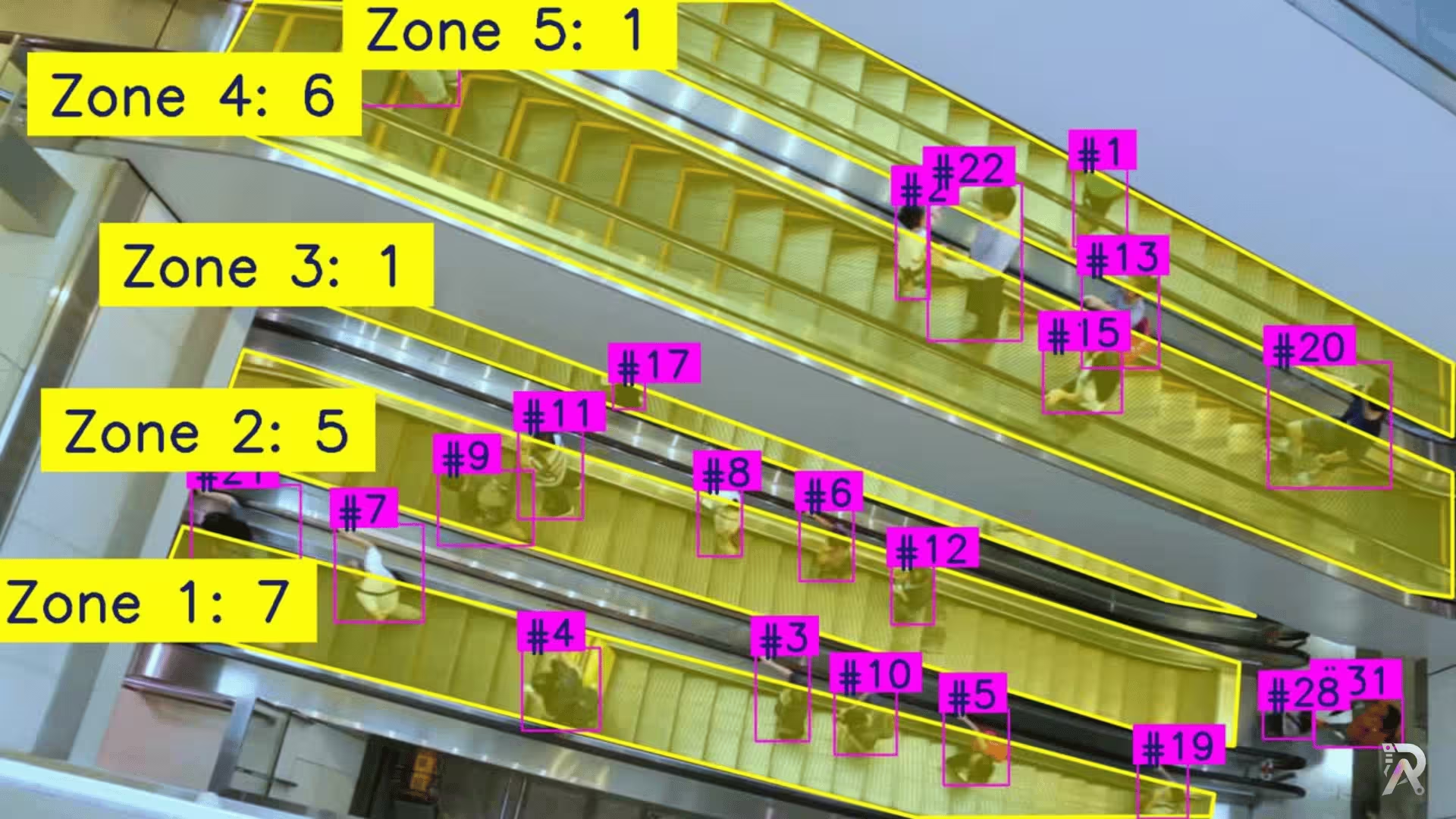 YOLO26June 23, 2026
How to count people in zones with YOLO26 and OpenCV
Frequently asked questions
- Is ByteTrack faster than FastTrack?
- On an NVIDIA H100 with yolo26n.pt, ByteTrack ran at 106 FPS and FastTrack at 104 FPS end to end, detection included. Across all 10 GPU tiers ByteTrack was ahead on 5 and FastTrack on 5. The ranking is not constant across the range, so check the tier you will deploy on.
- Which holds object IDs better, ByteTrack or FastTrack?
- ByteTrack. On the same clip it recorded 17 ID fragmentations against 24, across 14 unique IDs for ByteTrack and 12 for FastTrack, with average track lengths of 66.9 and 83.8 frames. These results come from this clip and detector; different footage, detections or settings can change the outcome.
- Is ByteTrack or FastTrack cheaper to run?
- ByteTrack, at $0.0103 per 1,000 frames on an NVIDIA H100 versus $0.0106. The difference is occupancy: the slower tracker holds the GPU longer per frame, so the cost gap tracks the speed gap.
- Can ByteTrack and FastTrack run in real time?
- ByteTrack sustained 30 FPS or better on 10 of the 10 GPU tiers and FastTrack on 10. Per frame on an NVIDIA H100 that is 9.4 ms and 9.6 ms respectively. Anything under 33 ms per frame keeps up with a 30 FPS camera.
- Should I choose ByteTrack or FastTrack?
- Choose ByteTrack for real-time apps, edge devices, most general-purpose tracking. Choose FastTrack for teams that want high FPS without ByteTrack's occasional ID churn. The fast, lightweight default that just works. Near-ByteTrack speed with much steadier IDs.
- Does a more expensive GPU make tracking more accurate?
- No. A faster GPU only makes tracking run faster; it does not change how accurately the tracker follows objects. Accuracy and ID-stability depend on the tracking algorithm and your detector, not the hardware. That is why this page reports speed per GPU, but ID-stability only once.
- How was this YOLO tracker benchmark run?
- Every tracker ran on the same 200-frame clip with the same yolo26n.pt detector, on each of the 10 GPU tiers. FPS is the end-to-end detection-plus-tracking rate. All six trackers are built into Ultralytics, so results are reproducible with a single script.